AI implementation
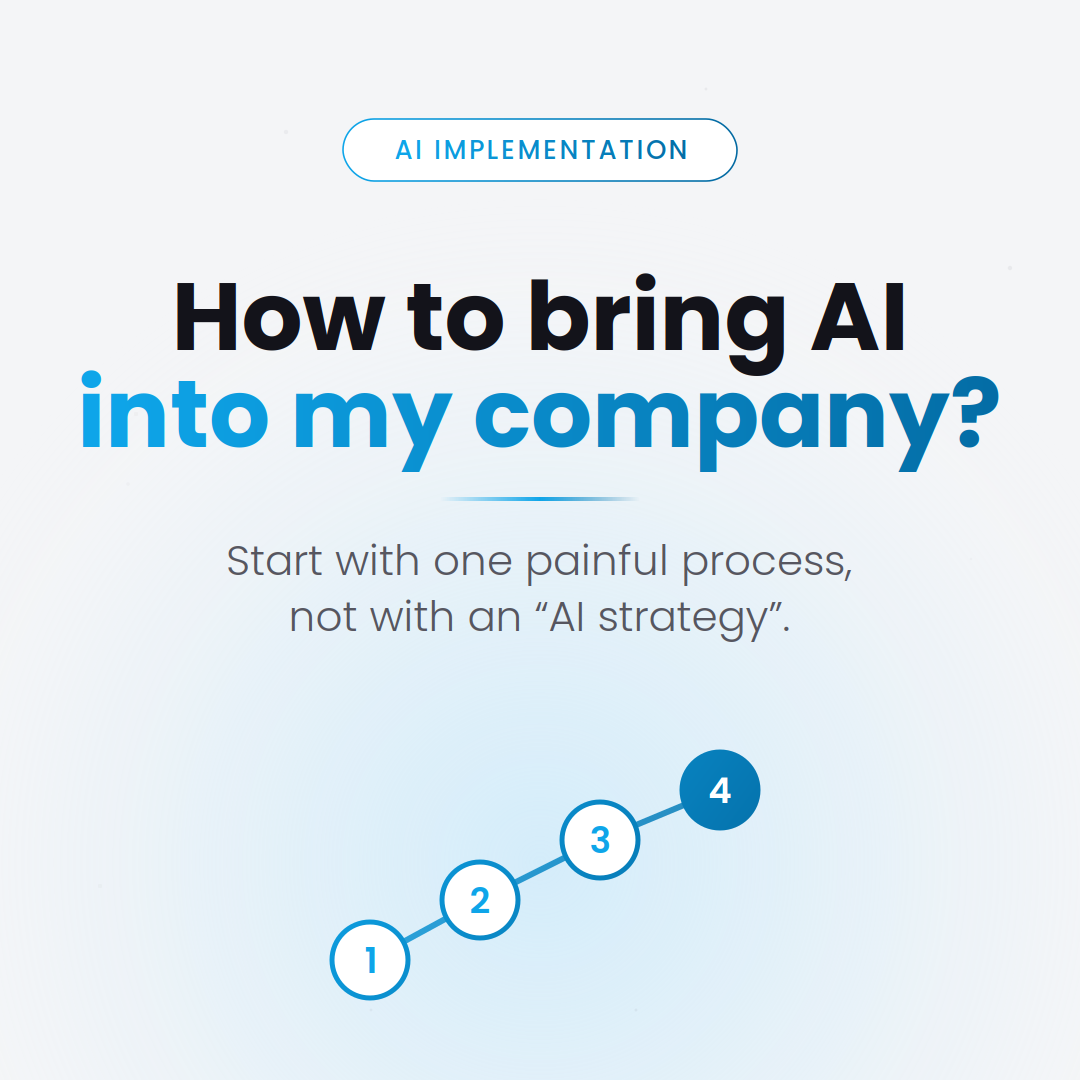
Start with a single painful process, not an "AI strategy."
Companies that successfully deploy AI into production have one thing in common: they started with a process, not a strategy.
In short
Implement AI in your company in four steps: choose a repetitive process with measurable impact, map existing data and systems, build a 30-day pilot with human-in-the-loop (a human involved in the validation loop of automated decisions), then expand only where the ROI (Return on Investment) is proven. Don't start with "AI transformation," but with a concrete use case.
- Choose 1 high-volume process with stable rules
- Map existing data and systems (CRM — Customer Relationship Management, ERP — Enterprise Resource Planning, email)
- Deliverable pilot in 30 days, with human-in-the-loop
- Expand only based on measured ROI, not enthusiasm
Step 1 — choose the process, not the technology
The biggest mistake: "we want AI." The correct question: which process consumes most of your hours weekly, has relatively stable rules, and an error cost you can quantify? That's the candidate. Email triage, lead qualification, data extraction from invoices/contracts, answering repetitive questions, document reconciliation — all have rapid ROI.
Step 2 — the data and systems you already have
Before any model, you map where the data comes from (CRM, ERP, Drive, SharePoint, email), where the results go, and who signs off on approvals. 80% of AI implementation failures don't come from the model, but from poor data hygiene and missing integrations.
- Data sources: CRM, ERP, files, email, ticketing
- Target systems: where the AI writes the result (CRM, Slack, M365 — Microsoft 365 suite)
- Who approves: roles, escalations, audit log
Step 3 — the 30-day pilot, in production
Not a POC (Proof of Concept — feasibility demonstration) in a sandbox. A pilot connected to real data, used by real people, in parallel with the old process (shadow mode). Start with human-in-the-loop — the AI proposes, the human approves — then gradually increase autonomy as confidence and accuracy justify it.
Step 4 — expansion, only on evidence
After 30 days, you have data: hours saved, error rate, human escalation rate, team satisfaction. With the numbers on the table, you decide where to expand. Without numbers, you don't expand — you redo the pilot. This separates companies that deploy AI into production from those that remain at "experiments."